Why does the road bend here?
The bend is older than the bridge. It still follows a ford that no longer exists.

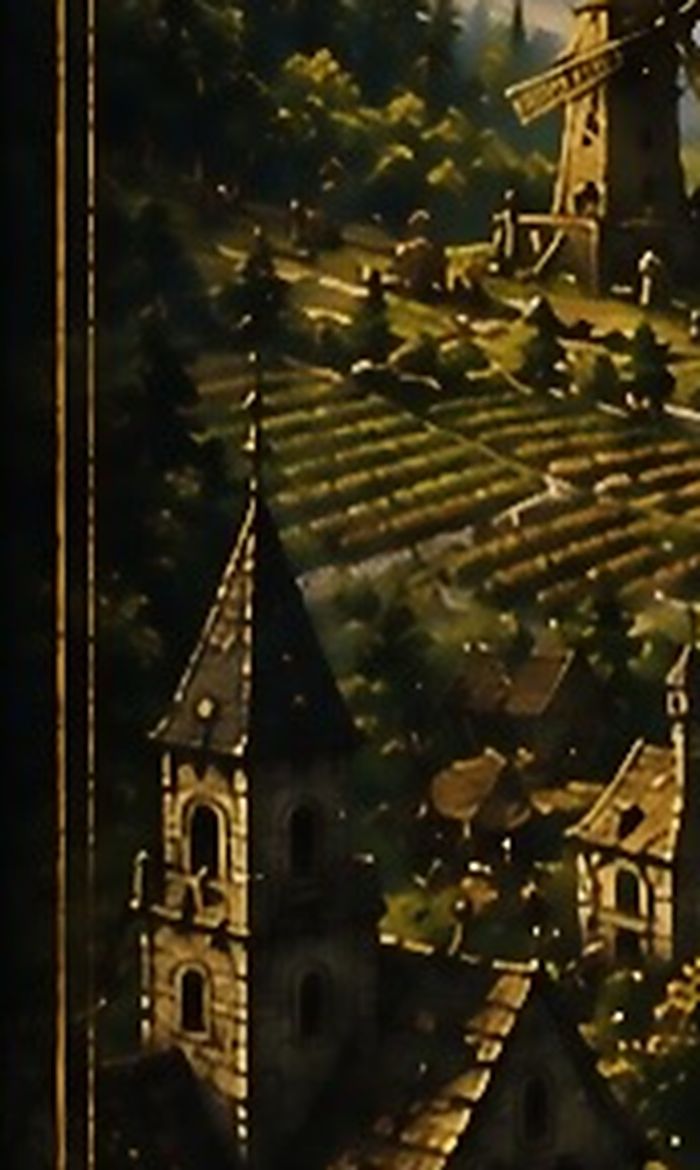
What happened here?
History left something behind.
History Isn’t Written.
It’s Lived.
A living historical simulation by RealityEnginuity, LLC.
Chapter the First — The World
What if the world didn’t wait for you?
A river cuts where the rock is soft, and silt gathers on the inside of the bend. The soil there is better than the soil upstream, so someone plants there. Then someone stays.
None of that was arranged for you to find. It happened because water moves and people are practical, and it happened long before you arrived.
Atlas is running now. It keeps running whether or not anyone is watching. When you open it, you are not starting a world — you are arriving somewhere in the middle of one.
Every map begins as a question.
Chapter the Second — The Instrument
Wind the driving wheel, and six hundred years turn behind it.
Climate, water, soil, and what will grow in them. This layer is driven; everything after it is driven by it.
Households form where the ground will feed them. They are born, they leave, they found new ones.
Where enough households agree the same ground is worth staying on, a village exists — because they stayed, not because it was placed.
Two places that can reach each other exchange what the other lacks. Roads are the record of that, worn into the ground.
What a place values, remembers and writes down — and what it quietly stops writing down.
Six centuries later a child finds a ruin and asks who kept it.
No one authored that. There was no quest, no trigger, no scripted event waiting to fire. A river was shallow in one particular place, and everything else followed.
The engine is deterministic. The same world, replayed from the same beginning, produces the same history — exactly, every time, down to the last digit. That is not a technical curiosity. It is what makes the past knowable. Every ruin can be traced back to the season it was abandoned. Every road to the first person who walked it.
Believable worlds emerge from systems—not scripts.
RealityEnginuity, LLC
Chapter the Third — The Atlas
The Atlas is not a map you fill in. It is a book that has been kept — passed down, added to, argued with, repaired, and left unfinished by everyone who held it before you.
The Crossing · 118
The water is low here in the dry months. Wide, and slow, and shallow enough to walk. Three families crossed today with a cart and did not unload it.
— Aecel, the year 118
This is the ford. Everything after it begins here.
added in a later hand — unknown
Aldenford, in its prime · 312
Sixty hearths. Two mills. The market runs from first light and the road south is busy enough that we have begun to mend it without being told.
— kept by Maren, 312
what moves, and where it goes
Westmill · 411
Raised this spring below the weir. The water above the weir is faster, but it fails in August. Below, it is slower and it never fails. We chose never fails.
— 411
picked at the weir, the year the mill was raised
The Old Bridge · 642
Taken by the flood and rebuilt on the same piers. The stone at the base is older than any record we hold. We do not know who cut it.
There is a tower on the western ridge. It is a ruin. No one now living remembers who kept it, or why it was raised, or what it was meant to watch for.
ask at Aldenford
and here the hand stops.
What will your story be?
Folio I of V
Knowledge outlives kingdoms.
In Atlas, the greatest progression is not becoming more powerful.
It is becoming part of history.
Chapter the Fourth — Discoveries
Not screenshots. Things found, in the order you would find them: a question, then what was drawn, then what it turned out to mean.
The bend is older than the bridge. It still follows a ford that no longer exists.
The arches are from 642. The piers they stand on are not. No chronicle in the valley records who laid them.
Because carts keep to the valley road, and news travels with the carts. Nothing in Atlas moves faster than the thing carrying it.
Every entry above was produced by the simulation. None of them were written for it.
Chapter the Fifth — A Principle
Atlas does not open with a completed map. Some places are unnamed because no one has yet had reason to name them. Some events are unrecorded because no one was standing there when they happened.
Some records are simply wrong, because the person who wrote them was.
The world is fully simulated. Your knowledge of it is not. What you know is what was observed, written down, and survived — and those are three different filters, each one lossy.
This is not content held back from you. It is the honest condition of knowing anything about a place older than you are.
So go and look.
Chapter the Sixth — The Company
We build simulation, not scenery.
Chapter the Seventh — Development
Kept as a record rather than a changelog.
Entry the First
Climate, hydrology, soil and growth — closed, tested, and frozen. A hundred thousand turns of the world, replayed from the same beginning, arriving twice at the identical state. The valley is not a backdrop. It is the first thing that exists.
Entry the Second
The first people. The unit is not the individual but the household: people are born into one, leave one, and found another. Villages are what happens when enough households decide the same ground is worth staying on.
Entry the Third
Running centuries is the easy half. Explaining them is the work. The Observatory exists to answer one question about any moment in a world’s past: what changed, and what caused it?
Some histories are inherited.
Others are waiting to be discovered.